Why is it cheaper abroad?
307 things with a dated price in Da Nang and in the Netherlands, sorted by how much of the bill is somebody's time.
2026-09-19
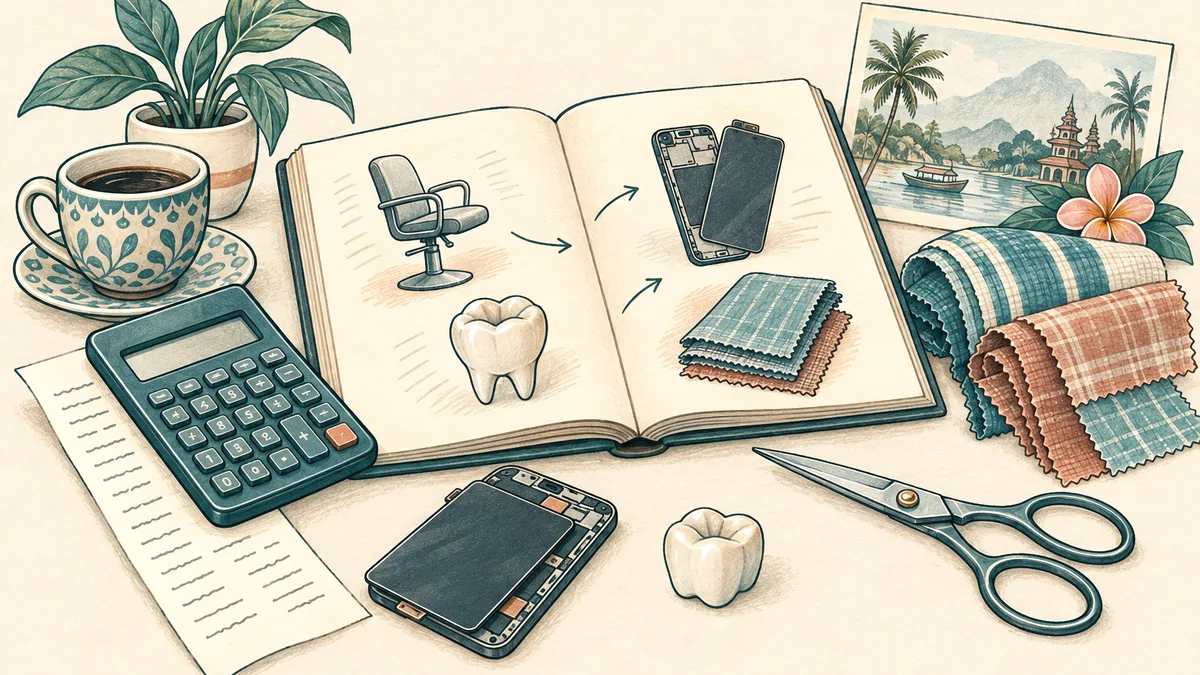
A men's haircut costs €33.50 in the Netherlands and €5.50 in Da Nang: 6.1 times cheaper. A new screen for an iPhone 16 costs €339 against €263: 1.3 times. Same city, same way of reading the price. Why is one gap so much larger than the other?
This page reads all 307 items on this site that have a dated price in Da Nang and a reference price in the Netherlands. The middle one is 5.4 times cheaper in Da Nang. The short answer to why:
- Wages are most of it. The average Dutch wage is about 15 times the Vietnamese one, and most of what you pay a dentist, a hairdresser or a doctor is somebody's time.
- Parts are almost none of it. A phone screen costs about the same everywhere, so the more of a bill is parts, the smaller the gap.
- The largest gaps are not about wages at all. They come from who sets the price, on both sides.
Every bill has two parts
One part is made on the spot: the time of the person doing the work, the room, the receptionist, the supplier around the corner. That part follows local wages. The other part travels: the screen, the fabric, the machine. It comes out of factories that sell to the whole world, so its price differs far less between Da Nang and Utrecht than an hour of work does.
Wages first. A single person on the average Dutch wage earns €5,053 a month before tax (Eurostat, 2025). The average wage worker in Vietnam earns 10 million dong a month, which is €329 (National Statistics Office of Vietnam, the first half of 2026). That is 15.4 times less. The two figures are not measured the same way, so read it as "about 15 times" and not as a precise number.
So something that is all time could be up to 15 times cheaper, something that is all parts should cost the same, and everything else should land in between, in the order of how much of the bill is time.
How much of a bill is time
Nobody can see inside one dentist's bill, but Eurostat can see inside the books of the whole trade. For every industry it publishes what the businesses take in, and what is left after they have paid for everything they buy in: parts, materials, goods to resell, rent, energy. What is left pays the people who work there, the owner included. For Dutch dental practices that is 58 cents of every euro. For hairdressers it is 64. For phone and computer repair shops it is 33, because most of the money goes straight through to whoever made the part.
The chart sorts the categories on this site by that share, and shows how many times cheaper each one is in Da Nang.
Most of the bill is somebody's time · 57 to 64% · middle item 7.9x
Most of the bill is parts, materials or goods · 24 to 36% · middle item 4.3x
Each row is a category. The scale is how many times cheaper it is in Da Nang than in the Netherlands, and it doubles at every step, so 2 to 4 is as wide as 20 to 40.
What the chart shows
The order holds, loosely. Where most of the bill is time, the middle item is 7.9 times cheaper in Da Nang. Where most of it is parts, materials or goods, it is 4.3 times. At the bottom sit vaccines (3.1 times) and bed linen, towels and decor (3.2 times): things that come out of a factory and cross a counter.
It is loose because the statistics are coarse. Eurostat has one line for all specialist medical practice, so a blood test that is mostly machine and a consultation that is all time get the same share. And some prices are not free to move: Dutch dental fees are legal maximums set by the healthcare authority, which is one reason dental work (4.1 times) sits lower than its share of time suggests. The fit is loose in places too: the Dutch clothing figure describes firms that buy in most of what they sell, while a suit in Hoi An is cut and sewn locally, which is why clothing (5 times) sits higher than its row suggests.
Everything sits above the simple sum. If only the share made on the spot were 15 times cheaper and the rest cost the same, dental work would be 2.2 times cheaper and phone repair 1.4 times. In our prices they are 4.1 and 4.2 times, and every other category sits above its simple sum too. The reason is that what a business buys in is not all parts from a factory: the dental lab down the road, the landlord, the accountant and the cleaner are paid at local wages too, in both countries. The statistics do not split bought-in parts from bought-in local work, so we cannot put a number on that.
Where wages stop explaining it
A gap larger than the wage gap cannot be wages. 63 of the 307 items are more than 15.4 times cheaper, and 47 of those are priced at a hospital in Da Nang. The clearest case is one visit to a specialist, the same Da Nang price against four countries:
| At home | In Da Nang | Times cheaper | What the price covers | |
|---|---|---|---|---|
| the Netherlands | €434 to €509 | €1.66 | 284x | a care product: one or two visits plus basic diagnostics |
| the United Kingdom | €291 | €1.66 | 175x | one private consultation in London, starting price |
| Australia | €64 | €1.66 | 39x | the national Medicare schedule fee for a first visit |
| Germany | €9 to €31 | €1.66 | 12x | one line of the fee schedule for private patients |
The Da Nang figure is a public hospital fee set by the Ministry of Health, a subsidised rate for residents, shown here because no clinic price for visitors has been found for this item yet. The Dutch figure is not one visit: Dutch hospitals do not sell a single consultation, so a patient who pays for it personally buys a care product that covers one or two visits plus basic diagnostics. The German figure is one line of the national fee schedule for private patients. The same visit to a doctor, priced by a state fee, a bundle and a fee schedule. The distance between 284 times and 12 times is the price system, not the wage.
That is why this site labels public hospital fees wherever it shows them, and why one percentage is a poor summary of medical prices. The method page says how each kind of price is treated.
What this does not say
- Nothing about quality. Two things with the same name are not always the same thing. Every item page says what the price covers, who published it and when.
- Nothing about the trip. Flights, days off and going back if something needs adjusting are in none of these figures. The guides work that out per category: dental work, phone and laptop repair, made-to-measure clothing.
- One city against one country. The sorting uses Dutch business statistics. The table below gives the same middle values for the other home countries on this site. The pattern is the same; the statistics are not theirs.
| Category | Netherlands | Germany | United States | United Kingdom | Australia |
|---|---|---|---|---|---|
| Physio, ENT and doctor visits | 31x | 3.3x | 26x | 39x | 21x |
| Skin and dermatology | 21x | 7.6x | 21x | 21x | 6.2x |
| Glasses and eye care | 15x | 7x | 7.9x | 4x | 8.5x |
| Blood tests and health checks | 9.4x | 3.2x | 11x | 16x | 6.4x |
| Hair, nails and beauty | 8.2x | 6.6x | 9.4x | 11x | 8.2x |
| Scans and endoscopy | 6.8x | 3.1x | 13x | 26x | 7.9x |
| Women's health | 4.4x | 2.3x | 5.8x | 11x | 2.5x |
| Massage, spa and gym | 4.2x | 3.3x | - | - | 3.9x |
| Dental work | 4.1x | 4x | 10x | 4.9x | 5.4x |
| Printing and bookbinding | 5.4x | 6.1x | - | - | 5.6x |
| Clothing, leather and shoes | 5x | 5.2x | 7.8x | 5.8x | 3.3x |
| Phone, laptop and watch repair | 4.2x | 2.3x | 2.4x | 3.8x | 3.9x |
| Curtains, blinds and bedding made to measure | 4.2x | 4.1x | - | - | - |
| Bed linen, towels and decor | 3.2x | 3x | 3.4x | 4x | 1.9x |
| Vaccines | 3.1x | 3.2x | 4.6x | 4.2x | 2.4x |
A dash means fewer than 5 items can be compared for that country. The quarterly report carries the full comparison for every pair of countries.
What economists call it
Two names are worth knowing. The Penn effect: prices are lower in poorer countries, because what cannot be shipped, a haircut, is priced off local wages, while what can be shipped, a phone, is not. Baumol's cost disease: over the years hands-on work gets dearer compared with goods, because a factory makes more phones per hour every year and a barber does not cut more hair per hour. Together they say what the chart says: the gap is in the hands.
Method and sources
- Times cheaper is the middle of the Dutch reference price divided by the middle of the cheapest current price in Da Nang, both in euro, per item. A public hospital fee or a rough price only counts as the cheapest when nothing firmer exists for that item. Read on 2026-09-19 and frozen: the item pages move with every new price, this page does not until it is read again.
- A category gets a row when at least 5 of its items can be compared. The dot is the middle item, the bar runs from the lower quarter to the upper quarter.
- The share of the bill that is time is value added as a share of net turnover, Netherlands, 2023, from Eurostat structural business statistics (table sbs_ovw_act, read 2026-09-19). Value added also pays for the owner and for worn equipment, so it is the upper edge of "time". The industry that stands in for each category:
| Category | Items | Dutch industry used | Share that is time | Fit |
|---|---|---|---|---|
| Physio, ENT and doctor visits | 23 | Specialist medical practice activities (Q86.22) | 63% | close |
| Skin and dermatology | 20 | Specialist medical practice activities (Q86.22) | 63% | close |
| Glasses and eye care | 12 | Specialist medical practice activities (Q86.22) | 63% | loose |
| Blood tests and health checks | 31 | Other human health activities (Q86.90) | 64% | loose |
| Hair, nails and beauty | 14 | Hairdressing and other beauty treatment (S96.02) | 64% | close |
| Scans and endoscopy | 12 | Specialist medical practice activities (Q86.22) | 63% | loose |
| Women's health | 36 | Specialist medical practice activities (Q86.22) | 63% | close |
| Massage, spa and gym | 7 | Physical well-being activities (S96.04) | 57% | close |
| Dental work | 27 | Dental practice activities (Q86.23) | 58% | close |
| Printing and bookbinding | 13 | Other printing (C18.12) | 36% | close |
| Clothing, leather and shoes | 15 | Manufacture of other outerwear (C14.13) | 31% | loose |
| Phone, laptop and watch repair | 65 | Repair of computers and communication equipment (S95.1) | 33% | close |
| Curtains, blinds and bedding made to measure | 10 | Manufacture of made-up textile articles, except apparel (C13.92) | 36% | loose |
| Bed linen, towels and decor | 8 | Retail sale of textiles in specialised stores (G47.51) | 24% | loose |
| Vaccines | 14 | Dispensing chemist in specialised stores (G47.73) | 25% | loose |
- The simple sum is 1 / (1 - s + s / g), with s the share and g the wage gap of 15.4.
- Wages are converted at 30,400 VND to the euro (2026-08-27).
Something wrong? Every item page has a correction form, or write to [email protected].