Paying in Vietnam: what cards, ATMs and cash actually cost
The exchange rate is the one thing you do not have to think about in Vietnam. A card and an ATM both give you something close to the interbank rate, and changing cash at a shop gets you roughly the same. Choosing between them on the rate is choosing between nothing and nothing.
What costs you money is everything layered on top: the fee your own bank charges, how little a Vietnamese machine lets you withdraw at once, and the surcharge a shop adds when you hand over a card. That last one is the biggest, and almost nobody mentions that it is against the rules.
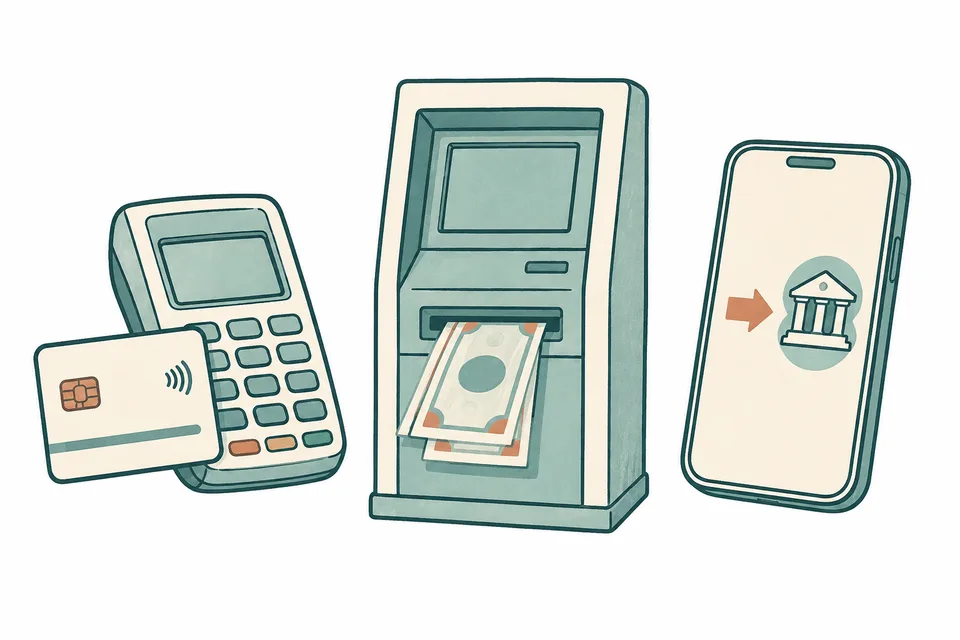
The short answer
- Up to a few hundred euro. Pay by card, and specifically by a card with no conversion cost: Revolut or Wise. Choose Vietnamese dong rather than euros and you can stop reading. Your normal bank card works too, it just adds about 1.2% plus a fixed fee to every purchase.
- A few hundred up to about €1,500. Take cash out at a VPBank machine, which allows 20,000,000 VND in one go. With Revolut the first €200 a month is free and everything above it costs 2%; an ABN AMRO debit card costs €2.25 plus 1.2% per withdrawal. Or pay by card, with the same two cards, and ask about a surcharge before you agree to anything.
- Larger than that: a dental plan, implants, a tailor's order. No card and no ATM. Ask the business for its bank details and send the money with Wise. On a €2,400 bill that is roughly €15 instead of roughly €120.
Always pay in dong
A terminal or an ATM will often offer to charge you in euros instead of dong. It looks like a courtesy. It is a worse rate, normally 3 to 6 percent worse, and it is set by whoever owns the machine rather than by your own bank.
Choose VND every time, and decline the conversion when a screen offers it. This is the easiest money on this page, and it applies to every card in the table below.
What your own card costs
| Card | Paying in a shop | Taking out cash | The catch |
|---|---|---|---|
| Revolut Standard | free up to €1,000 a month | free up to €200 or 5 withdrawals a month, then 2%, at least €1 | 1% above €1,000 a month, and 1% at weekends |
| Wise | the mid-market rate plus about 0.4 to 0.7% | free up to €250 a month, then a percentage | the conversion fee applies whether you spend or withdraw |
| ABN AMRO debit card | €0.15 plus 1.2% | €2.25 plus 1.2% | the 1.2% sits on top of the rate, on every single purchase |
| A credit card | usually 1.5 to 2% | a cash advance fee as well, and interest from the first day | never put a credit card in an ATM |
Two cards cover almost everyone: Revolut or Wise for daily spending, and your normal bank card as the backup for when a machine rejects the first one. Do not rely on a single card.
Vietnamese machines: the cap matters more than the fee
A Vietnamese ATM decides how much you may take in one transaction, and that limit, not the fee, is what makes cash expensive. Every withdrawal is a separate charge, so a machine that hands out 2,000,000 VND at a time costs you ten times what one handing out 20,000,000 VND does.
| Bank | Most per withdrawal | What the machine charges |
|---|---|---|
| VPBank | 20,000,000 VND, about €670 | no fee for foreign cards |
| ACB | 3,000,000 VND, about €100 | a surcharge for foreign cards |
| TPBank | varies | about 3.3% since June 2025, it used to be free |
| Most others | 2,000,000 to 5,000,000 VND | 22,000 to 55,000 VND per withdrawal |
At roughly 30,000 dong to the euro. The machine has to show its own fee before you confirm, so read that screen: these change, and a bank that was free last year may not be now.
The 3 to 8 percent shop surcharge
Hotels, clinics, tour operators and tailors regularly add 3 to 8 percent when you pay by card, and will explain that it is the bank's fee.
It is not, and it is not allowed. Article 8 of the State Bank's Circular 19/2016/TT-NHNN prohibits a business that accepts cards from charging the cardholder extra, or from pricing a card payment differently from cash. If you were charged anyway, you can complain in writing to the bank that issued your card, within seven working days.
That will not win you an argument in a tailor's shop in Hoi An. It does change the conversation, and it is the reason the surcharge is so often dropped when you ask. Ask before the work starts, not when the bill arrives.
A large bill, four ways
A €2,400 course of implant treatment, which is an ordinary reason to be reading this site at all:
| How you pay | What it costs you |
|---|---|
| Card, with a 5% surcharge from the clinic | about €120 |
| VPBank ATM, Revolut above its free band | 4 withdrawals, about €48 |
| Cash carried from home | 1 to 3% to buy the currency here, about €24 to €72 |
| Transfer to the clinic's bank account with Wise | about €15, arriving in minutes |
Illustrative costs from the table above.
The transfer wins by an order of magnitude and is the option no travel article mentions, because there is no commission on it. You do not need a Vietnamese bank account to send one: the clinic has the account, you only need its details.
Agree it before treatment starts, ask for the invoice first, and never send money to somebody's personal account when you are paying a business.
Cash
The advice to bring crisp $100 bills is American advice. Americans get their dollars for nothing. From the Netherlands or Germany you buy those dollars first, at 1 to 3 percent, and the advantage is gone before you land.
Only banks and licensed exchange agents may legally change money in Vietnam. A good number of the gold shops that do it are not licensed, the offence covers the customer as well as the shop, and the fine scales with the amount. A licensed agent displays a State Bank certificate. A bank asks for your passport and gives you a receipt, which is the version with no downside.
Up to $5,000 or the equivalent, and up to 15,000,000 VND, may be brought in without a declaration. Above either figure, declare it at customs on the way in and keep the form for the way out.
What would be cheapest, and why you probably cannot use it
Vietnam runs on QR bank transfers. Locals pay for nearly everything by scanning a code, it costs nothing, and no merchant adds a surcharge to it. It needs a Vietnamese bank account.
Since 2026 the banks generally do not open accounts on a tourist visa: a long-stay visa or a temporary residence card is the usual requirement. If you have one, open an account, and almost everything on this page stops applying to you. Cryptocurrency exchanged peer to peer is common in Vietnam and is not a legal way to change money, so it is not covered here.
Before you go
- Switch your card on for worldwide use before you fly, and take a second card.
- Choose dong, every time, and decline any offer to convert.
- Use VPBank machines: the same cash in fewer withdrawals.
- Ask about a card surcharge before the work starts.
- For anything over about €1,500, ask for bank details instead of paying by card.
- Keep receipts, particularly for anything you may need to prove later.
Where these figures come from
All figures were checked on 8 September 2026. Bank tariffs change and a Vietnamese machine can change its fee overnight, so the screen in front of you is the authority, not this page. This page is about what the ways of paying cost. It is not advice about which bank to use.
- Revolut Netherlands, personal fees (Standard)
- Wise, ATM withdrawal structure and fees
- ABN AMRO charges for cards abroad, as summarised by Wise
- Withdrawal caps and fees at Vietnamese banks
- VPBank's limit of 20,000,000 VND per withdrawal, with no fee for foreign cards: checked in September 2026. The guide above still gives 10,000,000 VND.
- Circular 19/2016/TT-NHNN, Article 8, on surcharges
- Vietnam customs, cash declaration thresholds